

Temperature Measurement with Thermocouples
However, the quality of the measurement depends not only on the probe itself, but also on the correct selection of the thermocouple type, cold junction compensation, and the proper evaluation of the sensor signal. A thermocouple does not directly provide an absolute temperature, but rather a small thermoelectric voltage resulting from a temperature difference. Therefore, the design of the measurement input is an essential component of the entire measurement chain.
What is a Thermocouple?
A thermocouple is a temperature sensor consisting of two different metallic conductors or alloys that are connected at a junction. When a temperature difference is created between this junction and a reference point, an electrical voltage in the millivolt range is generated. This voltage is measured, and the temperature is calculated from it. This is the basic principle behind all industrial thermocouples.
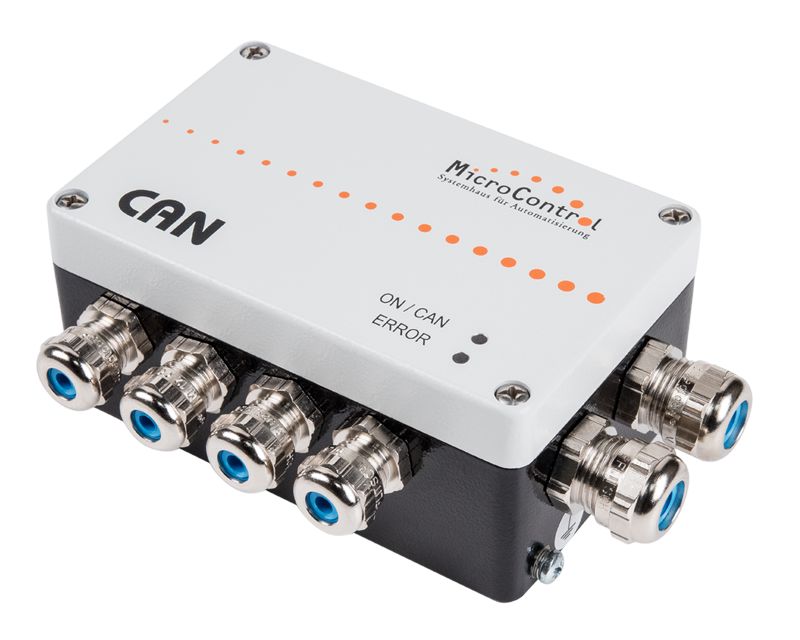
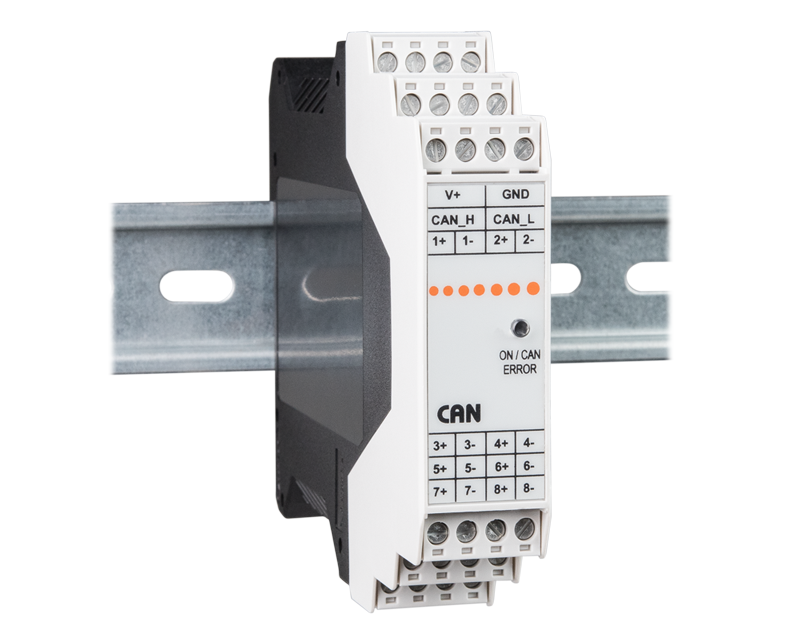
Thermocouples are available in many standardized types. The specific combination of materials determines the thermo type, such as type J, K, N, R or T. JEach thermocouple type has its own characteristic curve, a typical range of application, and specific behaviour in terms of sensitivity, temperature range, and long-term stability. MicroControl supports types J, K, N, R, and T in the µCAN.4.ti-BOX; the µCAN.8.ti-SNAP supports types E, J, K, L, N, R and T.
The Physical Principle of a Thermocouple
The fundamental physical principle behind a thermocouple is the Seebeck effect. When there is a temperature difference within a conductor, or between two different conductive materials, charge carriers respond to it to different degrees. This generates a measurable electrical voltage. In a thermocouple, this effect is specifically utilized by connecting two different materials at the measurement point. The resulting thermoelectric voltage depends on the temperature difference between the measurement point and the reference point, as well as on the materials used.
It is important to understand that a thermocouple does not directly measure an absolute temperature, but rather a temperature difference. The actual temperature at the measurement point can only be determined if the reference point is clearly defined and measured. This is precisely why cold-junction compensation is an indispensable part of any precise thermocouple measurement.
How does Temperature Measurement with Thermocouples Work?
In practice, the measuring junction of the thermocouple is located at the point where the temperature is to be measured. The other end of the thermocouple is connected to the measurement input. At this point, junctions are formed with other conductor materials, typically copper wires and the input structure of the measurement module. This connection point serves as the reference junction, which is often referred to as the cold-junction in thermocouple technolgy.
The measurement input detects the thermoelectric voltage of the sensor and converts it into a temperature value using the characteristic curve associated with the selected thermocouple type. It should be noted that the thermoelectric voltage of a thermocouple is not in an ideal linear relationship with temperature. The relationship between voltage and temperature depends on the specific thermocouple type and must be kept in mind accordingly during evaluation.
This is why for precise measurement results a simple linear conversion is insufficient. Instead, the temperature value is calculated using stored characteristic curves, polynomials, or lookup tables. In addition, the temperature of the reference point must be considered. Only the combination of voltage measurement, characteristic curve conversion, and cold junction compensation provides the correct temperature value at the measurement point.
Why is Cold-Junction Compensation Necessary?
Cold-junction compensation is necessary because a thermocouple does not measure absolute temperatures, but only the temperature difference between the measurement point and the reference point. In standard tables and characteristic curves, the thermoelectric voltage is usually referenced to a reference point of 0 °C. In real-life devices, however, the connection point of the thermocouple is not located in an ice bath of 0 °C, but typically somewhere on the module or in the control cabinet at a different temperature. This deviation must be compensated for.
Without cold junction compensation, the measurement input would evaluate only the existing temperature difference and thus provide an incorrect absolute temperature value. Cold junction compensation corrects this effect by additionally measuring the temperature at the reference point and including it in the calculation. In practice, it replaces the historical method of keeping the reference point constantly at 0 °C.
Cold-Junction Compensation at the Measurement Input
With MicroControl, cold-junction compensation is provided on the module or directly at the measurement input.
Measurement technology solutions from MicroControl
FAQ: Temperature Measurement with Thermocouples
What is the basic physical principle behind a thermocouple?
A thermocouple is based on the Seebeck effect. When there is a temperature difference, two different metallic conductors generate an electrical voltage. This thermoelectric voltage is measured and converted into a temperature value using the characteristic curve of the selected thermocouple type.
Why do I need cold-junction compensation?
Why is cold-junction compensation useful on the module?
Why isn’t a linear conversion of voltage sufficient for thermocouples?
How is the thermocouple voltage converted to a temperature value?
The conversion is performed using either characteristic curves, mathematical approximations, or lookup tables. In MicroControl devices, the thermocouple voltage is corrected by the software using lookup tables.
Why is it important to select the correct thermocouple type?
You would like to get more information?

+49 2241 - 25 65 9 - 0
Write an email or give us a call.