

Measurement of SG Signals
Strain gauge signals are typically measured using a Wheatstone bridge. In this process, the very small change in electrical resistance of a strain gauge is converted into a measurable voltage difference. Usually, this bridge voltage is only in the range of a few millivolts and is given as a ratio to the supply voltage in mV/V.
Strain gauges, or SGs for short, are used to measure mechanical strain. Depending on the sensor design, physical values such as force, weight, pressure, torque, or mechanical stress can be derived from the strain. Typical applications include force transducers, load cells, pressure sensors, test benches, machine monitoring, and mobile measurement systems.
Since strain gauge signals are very small, they require special measurement inputs. A standard analogue input for 0 to 10 V or 4 to 20 mA is generally not suitable for directly acquiring a strain gauge signal. Instead, strain gauge measurement modules are used, which provide a stable bridge excitation voltage, detect the small signal difference, and digitize the measured value with high resolution.
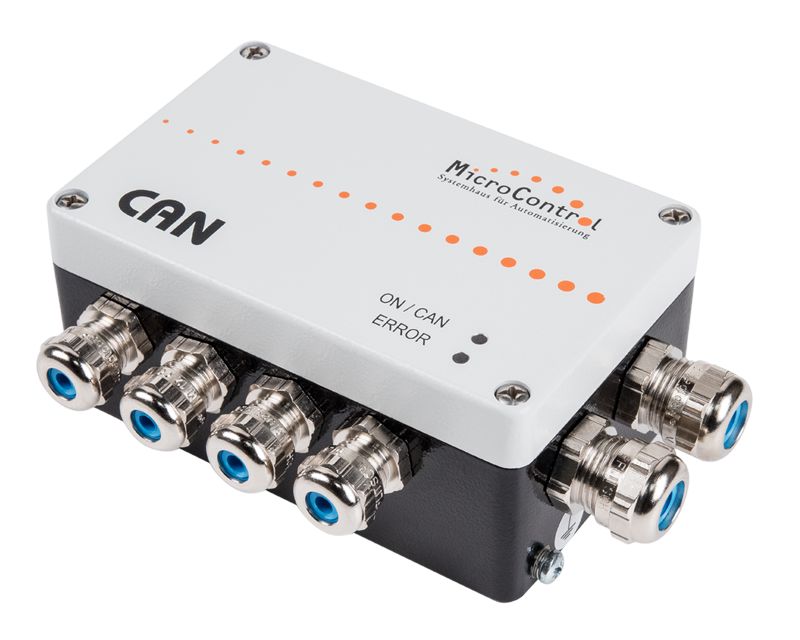
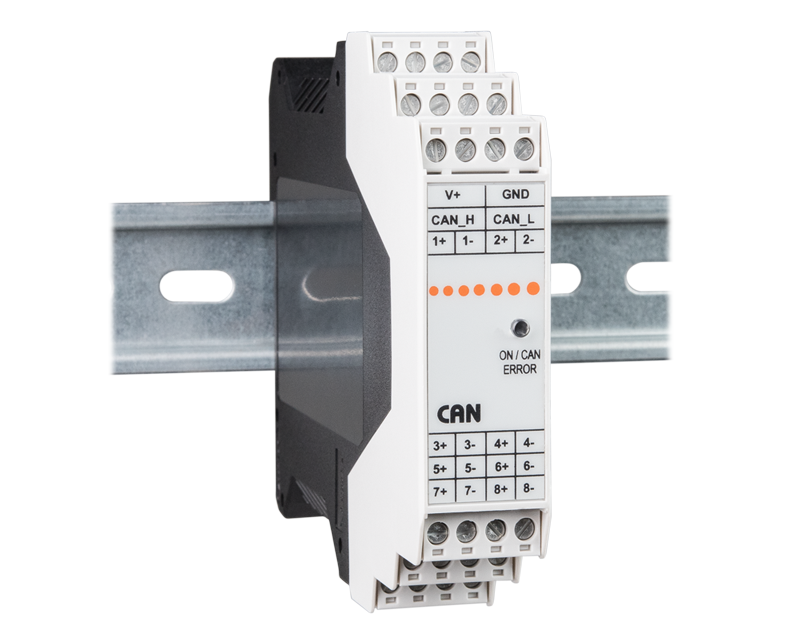
Modules such as the µCAN.4.sg-BOX are designed for this task. It directly acquires data from strain gauge or resistance bridges, provides the bridge excitation, and transmits the digitized measurement values via the CAN-Bus.
What is a strain gauge?
This change in resistance is very small. For this reason, a strain gauge cannot be evaluated in the same way as a conventional resistance sensor but is usually incorporated into a bridge circuit. The most important circuit for strain gauge measurement is the Wheatstone bridge.
How does measurement with a Wheatstone brigde?
A Wheatstone bridge consists This change in resistance is very small. For this reason, a strain gauge cannot be evaluated in the same way as a conventional resistance sensor but is usually incorporated into a bridge circuit. The most important circuit for strain gauge measurement is the Wheatstone bridge.
When unloaded, the bridge is ideally balanced. The voltage difference between the two measurement points is then very small or close to zero. When the strain gauge is mechanically stressed, the values of one or more resistors in the bridge change. This creates a voltage difference that is evaluated as a measurement signal.
The Wheatstone bridge offers several advantages for strain gauge measurements:
- it makes very small changes in resistance measurable
- it enables differential voltage measurement
- it reduces interference in a symmetrical configuration
- it can be configured a full-bridge, half-bridge or quarter-bridge
- it is suitable for precise force, pressure, weight and torque measurements.
What does full-bridge mean in the context of strain gauge signals?
In many industrial strain gauge transducers, the sensor is designed as a full-bridge. This means that all four arms of the Wheatstone bridge are designed as active or functionally effective strain gauge elements.
Depending on the mechanical design, some strain gauges are stretched while others are compressed. As a result, the signal components in the bridge add up. This increases sensitivity and simultaneously improves compensation for temperature effects.
A full-bridge strain gauge typically offers the following advantages:
- high measurement sensitivity
- good temperature compensation
- balanced bridge signal
- defined bridge impedance
- high immunity to interference during differential measurement
- direct connection to suitable strain gauge measurement inputs
Ready-made force transducers, load cells, pressure transducers, or torque transducers are often already designed as full-bridges. They can be connected directly to a suitable strain gauge measurement input.
What does mV/V in a strain gauge mean?
The output signal of a strain gauge transducer is often specified in mV/V. This value describes the ratio between the output voltage and the bridge excitation voltage.
A value of 2 mV/V means: at nominal load, the sensor provides an output voltage of 2 mV per 1 V of excitation voltage.
Example of a strain gauge sensor with 2 mV/V:
Many strain gauge sensors have a sensitivity of about 2 mV/V to 3 mV/V. With an excitation voltage of 4,096 V , this corresponds to a signal of about 8,192 mV to 12,288 mV at nominal load.
This clearly illustrates why strain gauge measurements require special inputs. The useful signal is very small and must be acquired with high resolution, low noise, and a stable bridge excitation voltage.
Measurement technology solutions from MicroControl
Why is bridge excitation important for strain gauges?
The bridge excitation provides the Wheatstone bridge with a defined voltage. Since the output signal of a strain gauge is proportional to the excitation voltage, the stability of the power supply directly affects measurement accuracy.
If the excitation voltage changes, the absolute output voltage of the bridge also changes. Therefore, strain gauge measurement modules must both provide a stable excitation voltage to the bridge and precisely measure the small differential voltage.
A specialized SG measurement module therefore performs several tasks simultaneously:
- power supply of the strain gauge bridge
- differential measurement of the bridge voltage
- high-resolution A/D conversion
- filtering of the measurement signal
- scaling to physical units
- transmission of measurement values to the controller or control system
FAQ: Measurement of strain gauge signals
How are strain gauge signals measured?
Why is a strain gauge measured using a Wheatstone bridge?
What does 2 mV/V mean for a strain gauge?
What is the difference between full-bridge SG and half-bridge SG?
What is a quarter-bridge SG?
Can a strain gauge be connected directly to a standard analogue input?
You would like to get more information?

+49 2241 - 25 65 9 - 0
Write an email or give us a call.