

Industrial Standard Signals: ±10 V and 0(4)…20 mA
Industrial standard signals such as ±10 V, 0…20 mA and 4…20 mA are among the most important elements of analogue measurement technology. They are used to transmit physical variables not directly as a technical unit, but as a standardised electrical signal. This allows sensors, measuring transducers, I/O modules and controllers from different manufacturers to be combined and measured values to be processed reliably.
In practice, these analogue signal ranges are not only relevant for the pure transmission of measured values. The diagnostic capability of the signal, the detection of fault conditions and the conversion into the actual process variable are equally important. Modern modules therefore not only record signals, but also provide functions such as limit monitoring, fault signalling and user-specific scaling.
What are analogue standard signals in industrial measurement technology?
Typical examples include:
- 0…10 V for 0…100%
- ±10 V for bipolar measured signals
- 0…20 mA for linear process signals
- 4…20 mA for industrial measuring circuits with fault detection
The advantage lies in standardisation. As long as all components involved support the same signal range, the measured value can be interpreted clearly and processed with little integration effort.
Voltage signals with ±10 V
Voltage signals are used when a measured value or control variable is transmitted as a potential difference. The ±10 V range is a typical standard for bipolar signals, i.e. for measured variables with both positive and negative value ranges.
A typical assignment is:
- -10 V corresponds to the negative full-scale value
- 0 V corresponds to the zero point or mid-point
- +10 V corresponds to the positive full-scale value
Voltage signals are easy to record, but they are more sensitive to cable resistance, electromagnetic interference and potential differences than current interfaces. Clean wiring and suitable input circuitry are therefore important.
Current signals 0…20 mA and 4…20 mA
Current signals are particularly widespread in industrial measurement technology because they can be transmitted robustly even over longer cable lengths. Compared with voltage signals, cable resistance has a significantly lower impact on the measurement result in many applications.
The two common standards are:
- 0…20 mA
- 4…20 mA
Both signal ranges are linear, but they differ significantly in terms of their diagnostic capability.
Why 4…20 mA is important as a living zero
The valid measuring range of a 4…20 mA sensor does not start at 0 mA, but at 4 mA. This principle is known as a living zero. The lower measured value is therefore deliberately not placed at the electrical zero point.
he assignment is as follows:
- 4 mA corresponds to the lower valid measured value
- 20 mA corresponds to the upper valid measured value
- 0 mA is not a valid process value and indicates a fault
This means that typical fault conditions such as cable breakage, sensor failure, interruption of the power supply or an interrupted signal path can be identified more clearly than with 0…20 mA or 0…10 V signals.
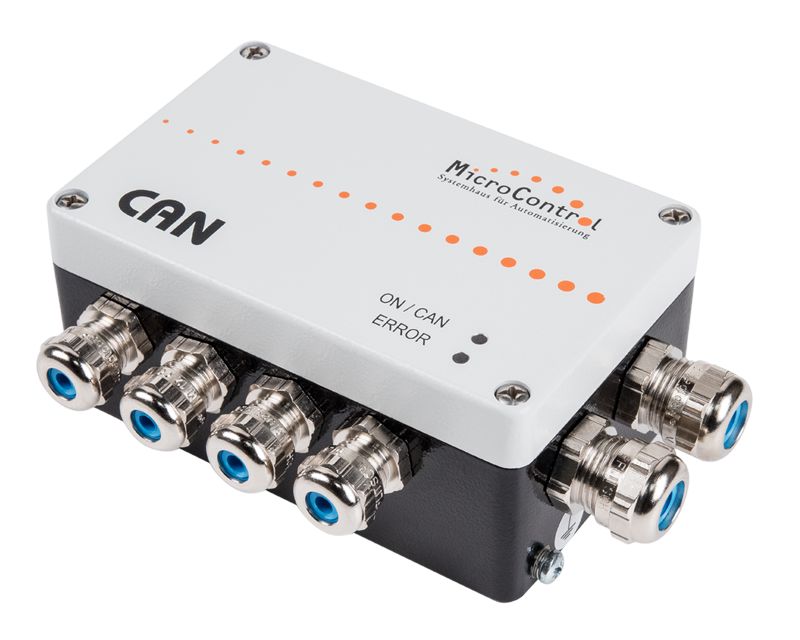
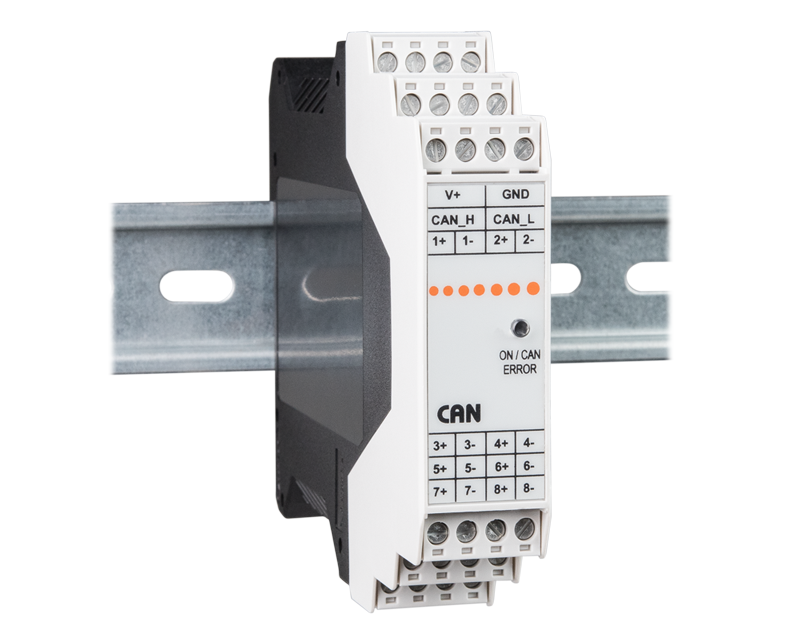
On modules such as the µCAN.4.ai-BOX or µCAN.6.ai-SNAP, this behaviour is monitored as standard: if the signal is outside the permissible range, the condition is detected as a fault and is output both via the CAN bus and via the LED signalling on the device.
Limit monitoring according to NAMUR
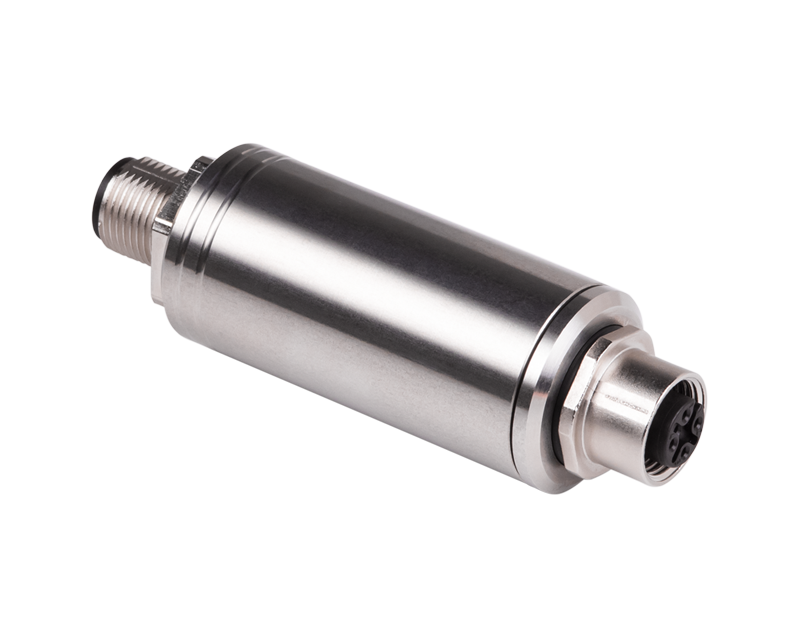
Measurement technology solutions from MicroControl
You would like to get more information?

+49 2241 - 25 65 9 - 0
Write an email or give us a call.